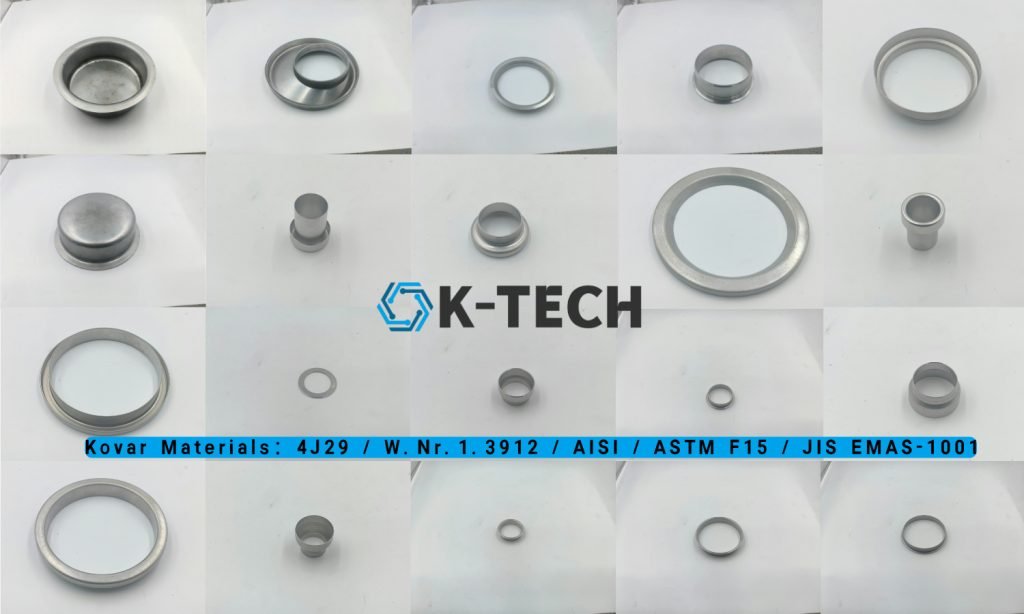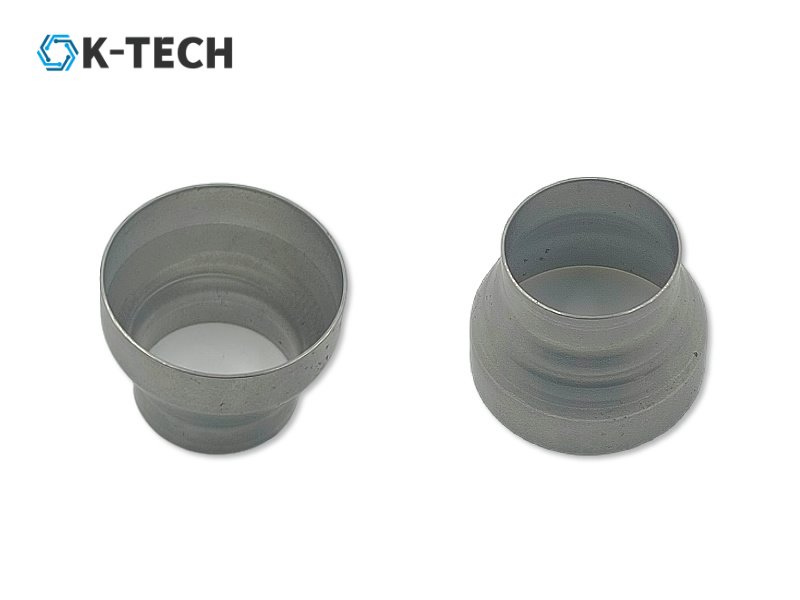
Kovar material (typically Fe-Ni-Co alloy 4J29) is widely used in electronic packaging, vacuum devices, and other fields due to its matching coefficient of thermal expansion with glass and ceramics. Its stamping process needs to be designed based on material properties (high strength, certain plasticity, easy oxidation), with the core being to ensure forming accuracy, surface quality, and subsequent processing performance. The specific process and key points are as follows:
I. Influence of Material Properties on Stamping
Key properties of Kovar alloy (taking 4J29 as an example):
- Mechanical properties: The tensile strength in the cold-rolled state is about 600MPa, with an elongation of 15-20%, showing certain work hardening;
- Chemical properties: Easily oxidizable (especially at high temperatures), and the oxide layer will affect welding and sealing performance;
- Forming requirements: Springback needs to be controlled (due to high elastic modulus), and dimensional accuracy must be ensured (tolerance of electronic packaging parts is usually ≤±0.05mm).
II. Stamping Process Flow and Key Points
1. Preparation Before Stamping
- Raw material selection: Cold-rolled Kovar strips (thickness 0.1-2mm) are usually used, with a smooth surface (Ra≤0.8μm), free of scratches and oxidation spots (to avoid cracking or surface defects during stamping).
- Softening annealing: If the material has severe work hardening after cold rolling (elongation <10%), annealing should be performed first:
- Temperature: 800-900℃ (too low temperature cannot eliminate stress, too high temperature may lead to coarse grains);
- Atmosphere: Pure hydrogen or ammonia dissociated gas (dew point ≤-40℃) to prevent oxidation;
- Heat preservation: 30-60 minutes, followed by furnace cooling to below 200℃ before.
After annealing, the hardness decreases to HV120-150, and the elongation increases to over 25%, facilitating forming.
- Blanking: According to the blank size, shearing or laser cutting is adopted (laser is recommended for thin materials <0.3mm to avoid edge curling). The perpendicularity of the blanking edge must be ensured (≤0.02mm/mm), with no burrs (burr height ≤0.01mm).
2. Core Stamping Processes
Depending on the part structure (such as cover plates, lead frames, shells), common processes include blanking, piercing, bending, drawing, etc. The key control points are as follows:
- Die design:
- Material: Cr12MoV (quenched to HRC58-62) or cemented carbide (YG15, suitable for batches >100,000 pieces) is used for the die/punch to ensure wear resistance;
- Clearance: The single-side clearance is 8-12% of the material thickness (upper limit for thin materials, lower limit for thick materials) to avoid excessive burrs or part deformation;
- Surface: The working surface of the die is polished to Ra≤0.08μm to reduce friction and scratches.
- Lubrication:
Low-residue, easily cleanable lubricants (such as volatile stamping oil or silicone-based grease) should be used to avoid residual oil affecting subsequent welding. For thin materials (<0.5mm), dry lubricants (such as molybdenum disulfide spray) can be applied; for thick materials (>1mm), extreme pressure emulsion (concentration 5-8%) is used. - Key process control:
- Bending: Kovar has large elastic springback (usually 3-5° for springback angle). The die should be designed with “over-bending compensation” (i.e., the bending angle is 3-5° larger than the design value), or coining bending (coining force is 1.5-2 times the nominal force) is adopted to reduce springback;
- Drawing: The first drawing ratio is 0.6-0.7 (larger value for thin materials). If multi-pass drawing is required, intermediate annealing (same as softening annealing process) should be inserted to avoid cracking due to work hardening; the blank holder force must be uniform (blank holder force = 0.2-0.3 × drawing force) to prevent wrinkling;
- Blanking/piercing: Progressive dies or compound dies are used (to improve efficiency) with positioning accuracy ≤±0.01mm (using guide pillars and bushes or servo feeding) to ensure hole position/shape tolerance.
3. Post-Stamping Treatment
- Deburring: Micro-burrs may remain on the edge of parts after stamping, which can be removed by:
- Vibratory finishing (using resin abrasives, 10-20 minutes): Suitable for small-sized parts;
- Electrochemical deburring: For burrs at complex holes and corners, with a current density of 5-10A/dm² and a time of 30-60 seconds.
- Cleaning: Remove surface lubricants and impurities using ultrasonic cleaning (solvent: anhydrous ethanol or trichloroethylene). After cleaning, vacuum drying is performed (80℃, 30 minutes) to ensure no oil on the surface (continuous and unbroken water film).
- Stress relief annealing: If the part has large deformation after stamping (such as deep-drawn parts), low-temperature annealing is required:
- Temperature: 600-700℃, heat preservation for 30 minutes (under protective atmosphere) to eliminate internal stress and stabilize dimensions (to avoid deformation during subsequent welding).
III. Common Problems and Solutions
- Cracking: Mostly caused by excessive deformation (drawing ratio <0.5) or oxide layers on the material. It is necessary to optimize the drawing ratio, increase intermediate annealing, or strictly control the surface quality of raw materials.
- Surface scratches: Due to rough die surface or insufficient lubrication. The die needs to be re-polished and the lubricant replaced.
- Dimensional deviation: Due to uncompensated springback or improper die clearance. Adjust the die angle and correct the clearance.
Kovar material stamping should focus on the core of “low oxidation, high precision, and few defects”. By means of reasonable annealing processes, die design, and parameter control, the formability of the material and the performance of the parts are balanced to meet the needs of high-precision scenarios such as electronic packaging.