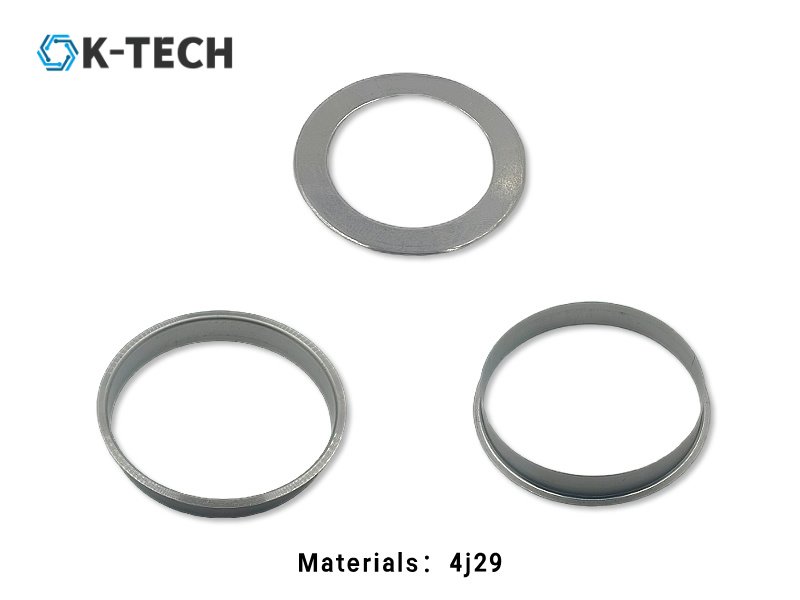
Kovar alloy is an iron-nickel-cobalt-based low-expansion alloy. Its composition is strictly controlled to match the thermal expansion characteristics of glass and ceramics, and it is widely used in glass-to-metal sealing for electronic packaging, vacuum devices, and other fields. According to industry standards (such as ASTM F-15, UNS K94610), its typical chemical composition is as follows:
Main Elements (mass percentage)
- Iron (Fe): 53.0%~54.0%
As the base metal, iron provides the structural strength and magnetic foundation of the alloy. - Nickel (Ni): 29.0%
The addition of nickel significantly reduces the coefficient of thermal expansion and enhances corrosion resistance. - Cobalt (Co): 17.0%
Cobalt further optimizes thermal expansion matching and improves high-temperature stability and oxidation resistance.
Trace Elements (mass percentage, maximum value)
- Silicon (Si): 0.2%
A small amount of silicon is used for deoxidation to improve casting performance. - Manganese (Mn): 0.5%
It assists in deoxidation and enhances machinability. - Carbon (C): 0.02%~0.04%
Carbon content is strictly controlled to avoid embrittlement and ensure welding and sealing performance. - Other elements:
Aluminum (Al), magnesium (Mg), zirconium (Zr), titanium (Ti), copper (Cu), chromium (Cr), molybdenum (Mo), etc., are usually ≤0.1%~0.2% each. They exist as impurities or trace additives and have little impact on overall performance.
Key Properties and Applications
- Coefficient of thermal expansion: Approximately 5.3~5.5 ppm/°C (20~500°C), which is highly matched with borosilicate glass (such as Pyrex), avoiding stress cracking caused by temperature changes.
- Mechanical properties:
Tensile strength is about 517 MPa, and elongation is 30%, combining toughness and workability, suitable for complex forming processes such as deep drawing and stamping. - Typical applications:
Electron tube pins, semiconductor packaging, X-ray tubes, microwave devices, and other scenarios requiring high-reliability sealing.
Production and Standards
Kovar alloy is usually produced by vacuum melting (such as VIM+VAR processes) to ensure compositional uniformity and purity, complying with standards like ASTM F-15 and AMS 7728. Its composition accuracy directly affects the consistency of thermal expansion. Therefore, manufacturers (such as Carpenter Technology and Eagle Alloys) ensure batch stability through strict quality control.
Comparison with Other Alloys
Compared with Invar (36% Ni-Fe), Kovar has a significantly higher cobalt content, allowing it to maintain low expansion characteristics over a higher temperature range. Alloy 52 (52% Ni-Fe), although lower in cost, has a slightly higher coefficient of thermal expansion and is suitable for scenarios with relatively loose requirements.
In summary, the composition design of Kovar alloy is the core of its ability to achieve glass-to-metal sealing. The precise iron-nickel-cobalt ratio and trace element control together ensure its unique thermomechanical properties.